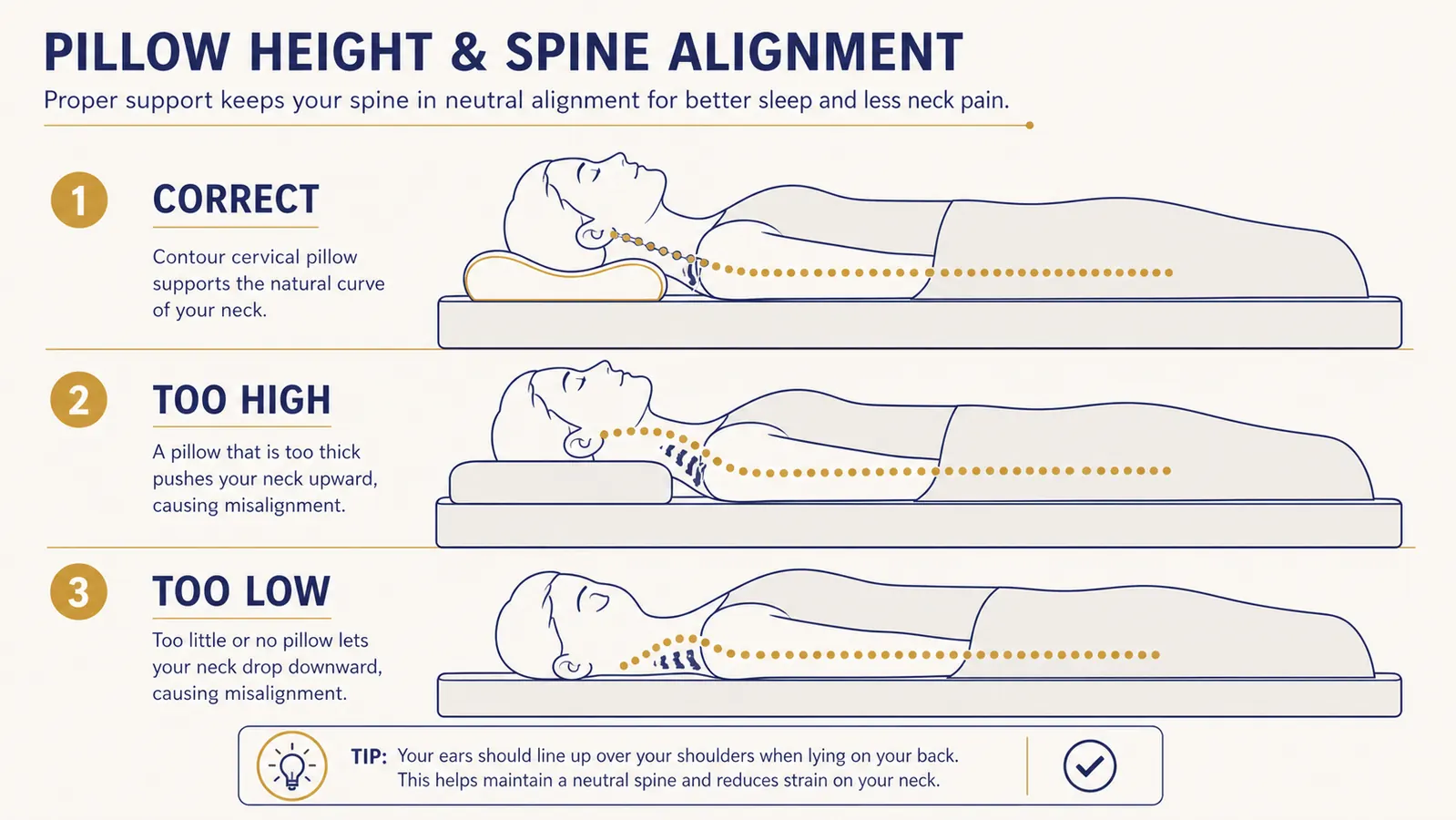

If a cervical contour pillow has not been part of your sleep setup, that single gap might explain why you keep waking up with neck stiffness every morning. The right cervical pillow holds your head in a neutral position through the night so the muscles along the sides and base of your neck are not working overtime to compensate for a pillow that is too flat, too thick, or too soft to maintain any real support.
Waking up stiff is not just an annoyance. It sets the tone for the whole day: the tension creeps into your shoulders, your mood drops before you even make coffee, and the problem repeats the following night because nothing in your setup has actually changed. The good news is that the fix is usually not complicated. It is a series of small adjustments, and the biggest one is choosing a pillow that matches the way your head, neck, and shoulders actually sit during sleep. This guide walks you through every step, starting with understanding what your body needs and ending with a simple morning routine that locks in the gains.
The cervical contour pillow most people start with has over 11,000 reviews and two height options built right in.
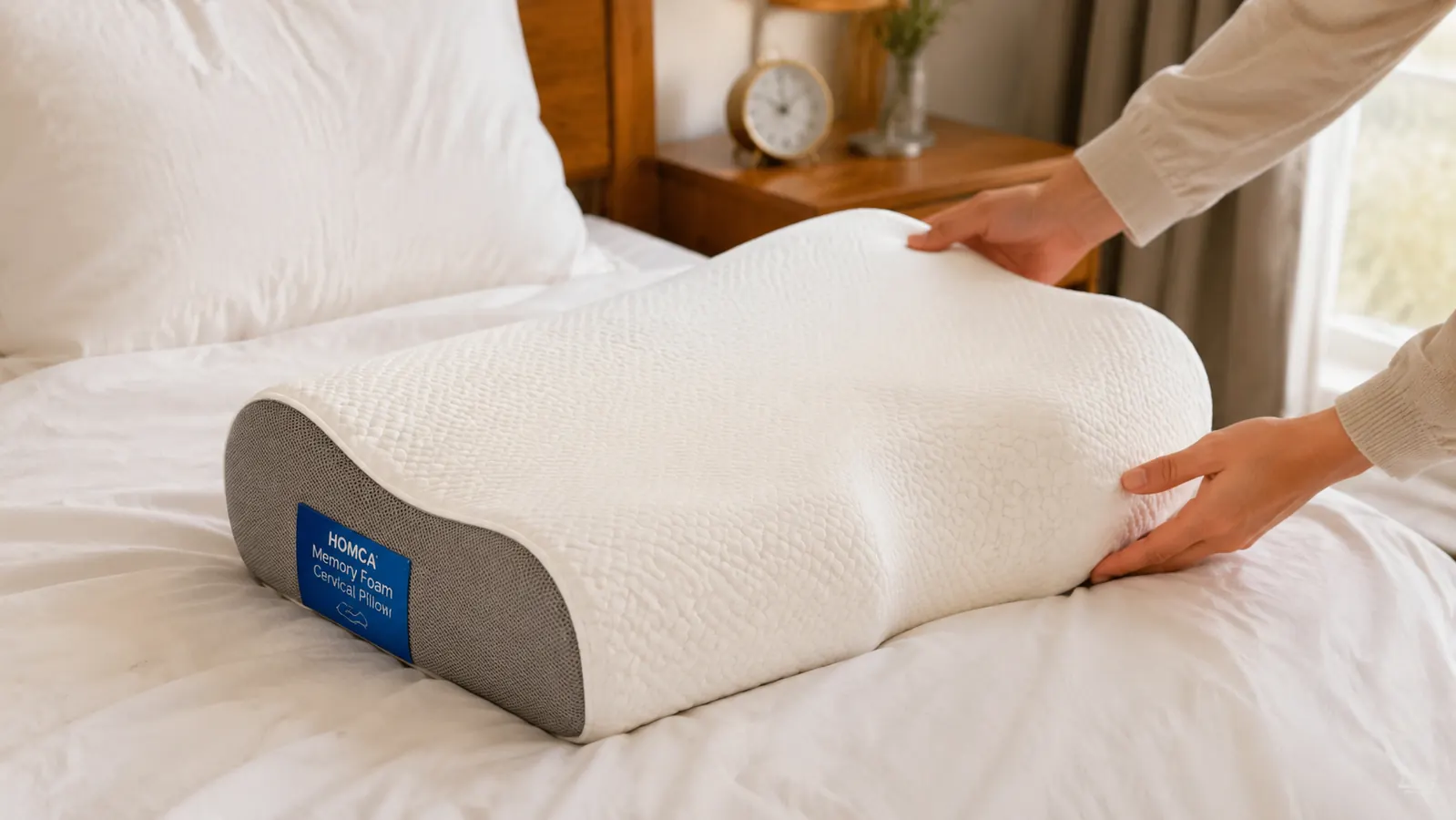
The HOMCA Memory Foam Cervical Pillow is shaped with a contoured curve that supports the natural arch of your neck whether you sleep on your side or your back. It comes with both a lower and a higher ridge so you can try both positions and find what feels best for your body without buying a second pillow.
Amazon Check Today's Price on Amazon →Step 1: Identify Your Sleep Position and What It Demands of Your Pillow
Before you swap any pillow, you need to know how you actually sleep. Side sleepers need a higher loft to fill the gap between the ear and the mattress so the head does not tilt downward all night. Back sleepers need a moderate loft that supports the cervical curve without pushing the chin toward the chest. Stomach sleepers have the hardest time of all because that position rotates the neck to one side for hours, which no pillow fully resolves. If you sleep on your stomach, the most useful adjustment you can make is gradually training yourself to sleep on your side or back by using a body pillow to prevent rolling.
A simple way to check your current alignment is to have someone photograph you from the side while you are lying in your typical sleep position. If your neck is bent upward or drooping downward, your pillow height is off. The goal is a straight, neutral line from the base of your skull to the middle of your back. Most people who do this check for the first time are surprised by how far off they are, because a misaligned position can still feel normal after years of sleeping that way.
Once you know your position, you have a concrete target for pillow height. Side sleepers generally do well with a ridge height of three to four inches, depending on shoulder width. Back sleepers tend to prefer two to three inches with a more gradual curve under the neck. Contour pillows that offer two built-in height ridges, one on each end, let you test both without buying two separate pillows or guessing in advance.
Step 2: Choose a Cervical Pillow That Matches Your Shoulder Width and Sleep Side
Not every cervical pillow is designed the same way. Some use slow-rebound memory foam that contours to the shape of your head and holds it there without shifting. Others use fiberfill or shredded foam that compresses under sustained pressure and offers less consistent support through the night. For side sleepers especially, solid memory foam contour pillows tend to perform better because they maintain their loft even with the full weight of the head pressing down for hours.
The HOMCA cervical pillow uses a single piece of solid memory foam shaped into a contoured wave with a lower ridge on one side and a higher ridge on the other. That design means side sleepers with broader shoulders can flip to the higher ridge for more elevation, while back sleepers or people with narrower frames can use the lower side. There is no fussing with removable inserts or adjustable chambers. You just flip the pillow and notice the difference.
Shoulder width matters more than most people realize when selecting pillow loft. A shorter person with narrow shoulders sleeping on their side needs less pillow height than a tall person with wide shoulders in the same position. If you have tried a cervical pillow before and found it uncomfortable, a height mismatch was likely the reason. Using a different height option, rather than abandoning the pillow type entirely, can change the experience completely. The HOMCA's dual-ridge design accounts for this in a single product, which is why it shows up consistently across positive reviews from both petite and larger-framed sleepers.
With over 11,000 reviews and a 4.3-star rating on Amazon, the HOMCA cervical pillow has enough real-world feedback to give a clear picture of how it performs across different body types and sleep positions. The volume of verified buyer experience is useful information in itself.
Step 3: Set Up Your Sleeping Surface So the Pillow Can Do Its Job
A good cervical pillow cannot correct alignment by itself if the surface beneath it is working against you. A mattress that sags in the center causes your whole spine to curve downward, and no pillow height compensates for that chain reaction. If your mattress is older than eight years and noticeably soft in the center, the neck discomfort you feel in the morning may be partly a mattress issue that no pillow alone will fix. A supportive mattress topper is often a lower-cost first step than replacing the mattress entirely.
For most people, the mattress is not the problem, and the issue is only with pillow placement. One thing worth checking carefully is whether your pillow is actually under your neck, not just under your head. Many sleepers push the pillow up to where it cradles only the back of the skull, leaving the neck unsupported and hanging slightly in the air. A cervical contour pillow works best when positioned so the curved section sits beneath the neck and the flatter central area cradles the back of the head. Getting that placement right the first night makes an immediate and noticeable difference.
If you sleep on your side, also pay attention to where your bottom arm goes. Tucking it under the pillow raises the height unevenly and tilts your neck sideways. Keeping the bottom arm in front of you or resting it flat along your side keeps the pillow position stable and lets the contoured shape work the way it was designed to.
Step 4: Give Yourself an Adjustment Period of at Least One Week
Switching from a soft, familiar pillow to a firm memory foam cervical pillow is a real change, and your body needs time to adapt. Most people who quit within the first two or three nights and conclude the pillow did not work were actually in the middle of an adjustment period, not past it. Your muscles have spent years compensating for a pillow that did not properly support your neck. When a contour pillow holds your head in a genuinely neutral position, those muscles may feel fatigued or mildly sore during the first few days as they relax and stop overworking.
A practical way to approach the transition is to use the new pillow for the first portion of sleep and allow yourself to switch back to your old one if you wake in the night and feel uncomfortable. Over the course of a week, most people find they are staying on the new pillow for longer stretches before switching, and the morning discomfort begins to ease. By the end of two weeks, the contour shape typically feels normal and the old flat pillow begins to feel inadequate by comparison.
It also helps to make sure the pillow cover is clean and breathable during the adjustment. Memory foam runs slightly warmer than fiberfill, and if you tend to sleep hot, a cotton or bamboo pillowcase helps with temperature. The HOMCA comes with a removable, washable cover, which simplifies this.
Three days in, a cervical contour pillow might feel too firm. Ten days in, your old pillow will feel like it offers nothing at all. The adjustment period is real, but so is what comes after it.
If soreness is significant and does not improve after two full weeks, it is worth checking in with a physical therapist or your doctor. Persistent neck discomfort sometimes has structural causes that a comfort adjustment alone will not resolve, and a professional can help you figure out what else might be contributing.
Step 5: Add a Simple Morning Stretch Routine to Lock In the Gains
A better pillow changes your overnight alignment, but spending a few minutes each morning on gentle neck stretches helps the muscles reinforce that benefit rather than reverting to old tension patterns. You do not need a complicated routine. Three basic movements done slowly and without forcing your range of motion are enough to start: a gentle side bend where you lower one ear toward the shoulder and hold for twenty seconds on each side, a chin tuck where you draw your chin straight back and hold for five seconds, and a slow neck rotation where you turn your head from side to side, pausing at the end of each direction.
These movements release residual overnight tension, improve circulation to the muscles that held your head all night, and help the neck settle into a neutral resting position as you move into your morning. Paired with a cervical contour pillow that supported that neutral position during sleep, the routine makes the whole system work together rather than relying on one element to do everything.
Doing the stretches before you check your phone, while you are still standing next to your bed, takes about three to four minutes. Most people who make this a consistent habit report that lingering morning stiffness clears faster than it used to, even during the first week. Small routine, real result.
What Else Helps
Pillow choice is the single biggest lever for reducing morning neck stiffness, but a few surrounding factors are worth addressing to get the full benefit. Keeping your bedroom cool, somewhere in the range of 65 to 68 degrees, reduces the restless tossing and turning that causes people to land in poor neck positions mid-sleep. Staying well hydrated through the day helps the intervertebral discs in your neck maintain their natural cushioning. Limiting screen time in the hour before bed reduces the forward-head posture that many people carry right into their pillow, because spending hours with your chin dropped toward a phone or tablet shortens the muscles at the front of the neck and tightens the ones at the back. None of these adjustments replaces the impact of choosing the right pillow, but together they create a sleep setup that works as a whole system rather than expecting one product to compensate for everything else.
If you wake up stiff more mornings than not, the pillow is the first and most important thing to change.
The HOMCA cervical pillow gives you two height options in a single piece of memory foam, shaped to hold the natural curve of the neck in a supported, neutral position through the night. More than 11,000 Amazon buyers have shared their experience with it. Check today's price and see if it fits your setup.
Amazon Check Today's Price on Amazon →